THE PROCESS

Forecast, build, operate, extract. Expand last.

The order matters more than the list. Every stage below exists to make the next one cheaper, and the last stage is deliberately the one nobody rushes to.

PHASE I · 01-03
Establish
Model the economics, design the offer and journey, build the system with attribution wired first.
PHASE II · 04-06
Run
Acquire, operate on cadence, and optimize one isolated variable per cycle against the forecast.
PHASE III · 07-08
Extract, then expand
Open the monetization layers already inside the funnel. A second mechanism comes only after that.
PHASE I · ESTABLISH

Nothing is built until the numbers are arguable.

Weeks 1 to 5, typically. The output of this phase is a system that can be read on its first run.
01

Forecast

We model your funnel economics before anyone builds anything. You see the break-even cost per registration, the contribution margin the offer supports, and which single assumption the whole plan is resting on. The plan gets argued from numbers rather than from taste.

1 to 2 weeksReviewed with you liveRe-run against actuals each month
WHAT YOU GET
Full funnel economic model, conservative to upside
Break-even cost per registration and per lead
The constraint of record, stated in writing
02

Architect

Offer structure, funnel journey, and run cadence are designed together, because changing one changes the others. VIP is priced here, not bolted on later. The backend rung is decided here, not discovered after the first run.

1 to 2 weeksOne decision documentSigned off before build
WHAT YOU GET
Offer and price ladder, including VIP
Funnel map from ad to backend
Run calendar and cadence commitment
03

Build

Pages, sequences, checkout, tracking, and the sales handoff get implemented as one system rather than five projects. Attribution is wired before spend goes live, because retro-fitting it means the first run cannot be read.

2 to 3 weeksAttribution integrity check before spendOwner named per variable
WHAT YOU GET
Registration, thank-you, replay, and checkout pages
Email and SMS sequences for reminder and replay
Tracking, conversion API, and attribution QA
PHASE II · RUN

Cadence is what turns opinions into data.

From week 5 onward. The same team, the same calendar, the same dashboard, every week.
04

Acquire

Paid acquisition goes live across Meta, Google, and YouTube with a testing structure designed to isolate one variable at a time. Budget moves on evidence, not on the reflex to move budget.

ContinuousYou pay platforms directlyRead on cost per registration and downstream revenue
WHAT YOU GET
Campaign and creative testing structure
Weekly creative production against the winning angle
Spend pacing tied to cost per registration
05

Operate

Recurring runs by the same team, on the same calendar, against the same dashboard. Show-rate mechanics, replay windows, and the sales handoff are run as operations rather than as launches.

Recurring runsOne accountable teamEvery number traceable to a run
WHAT YOU GET
Every run staffed and executed end to end
Reminder, show-up, and replay sequences run live
Live dashboard, no monthly slide deck
06

Optimize

Weekly review against every stage, with one change isolated per cycle so the learning actually compounds. The forecast is re-run against actuals, and the variance is the agenda.

WeeklyWritten variance noteNothing discarded between runs
WHAT YOU GET
Weekly review with the constraint named
One isolated change per cycle, logged
Forecast-versus-actual record per run
WHAT THE PROCESS REPORTS INTO

Every stage above writes to one dashboard.

The weekly review is held against this, not against a reconstruction of it. You have the same access we do, on the same day we do.
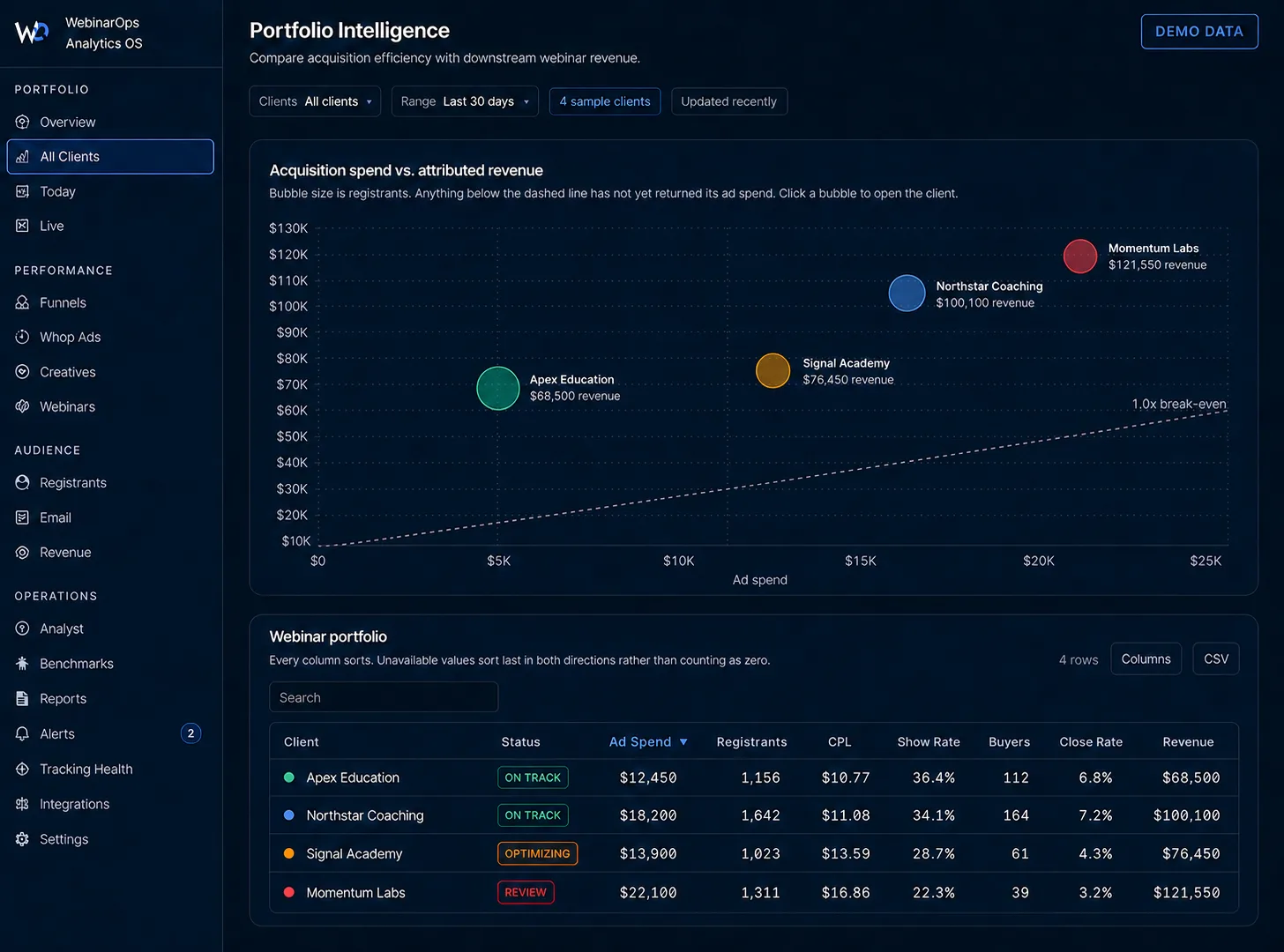
Portfolio view comparing spend against attributed revenue, shown with fictional demonstration data
Spend against attributed revenue with the break-even line drawn, plus the run-level table behind it. Interface shown with fictional demonstration data.
PHASE III · EXTRACT, THEN EXPAND

The cheapest revenue is the revenue already in the funnel.

Ongoing, once the mechanism is measured and improving.
07

Extract

Open the layers the funnel is not yet monetizing. VIP, replay deadline, order bumps, upsells, checkout recovery, and the backend rung are each worth more than a new mechanism, and each one is cheaper to test.

OngoingSequenced by expected valueMeasured on revenue per registrant
WHAT YOU GET
A ranked list of unopened monetization layers
One layer tested at a time, with its own economics
Revenue per registrant tracked as the headline number
08

Expand

A second mechanism is added only when the first one is measured, improving, and near the limit of what it can return. We earn the right to add complexity.

Only when earnedRequires a passing first mechanismForecast first, as always
WHAT YOU GET
A written case for the second mechanism
Its own forecast before any build
The first mechanism left instrumented and running
THE WEEKLY RHYTHM

What a normal week looks like.

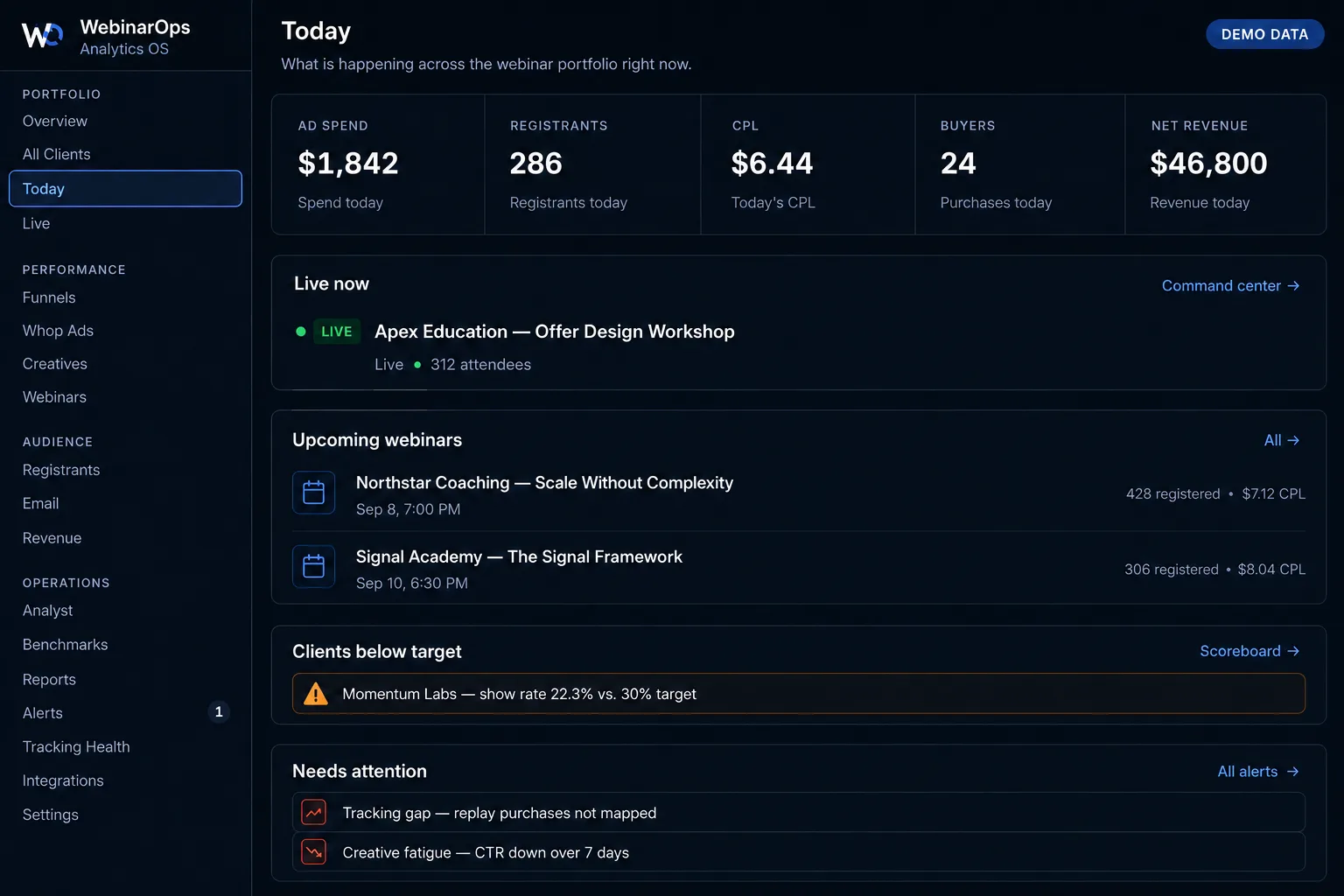
Daily operating view showing live and upcoming runs, shown with fictional demonstration data
Monday through Friday, the week is run against this view. Demonstration data.
MON
Review
Last run read against forecast. The constraint for the week is named.
TUE
Change
One isolated change shipped against that constraint. Logged with its expected effect.
WED
Run
Webinar goes live. Show-rate mechanics and the sales handoff run as scripted.
THU
Replay
Replay window and deadline sequence. Checkout recovery is worked, not left to email.
FRI
Reconcile
Numbers reconciled to source, variance written up, next week’s creative queued.
WE OWN
The forecast, and its accuracy against actuals
Funnel architecture, pages, sequences, and checkout
Paid acquisition, creative, and testing structure
Attribution, tracking integrity, and reporting
Run execution, cadence, and weekly optimization
YOU KEEP
The offer, the product, and the delivery of it
The brand, the audience, and every asset built
Ad accounts and spend, paid directly to the platforms
Subject-matter expertise and the person on camera
Final approval on offer, price, and positioning

Stage one starts with your numbers.

Six guided steps · roughly nine minutes · estimates, not guarantees

Build My Webinar Forecast